skip to Main Content
The Confession That Saved a Brand: The Domino’s Story

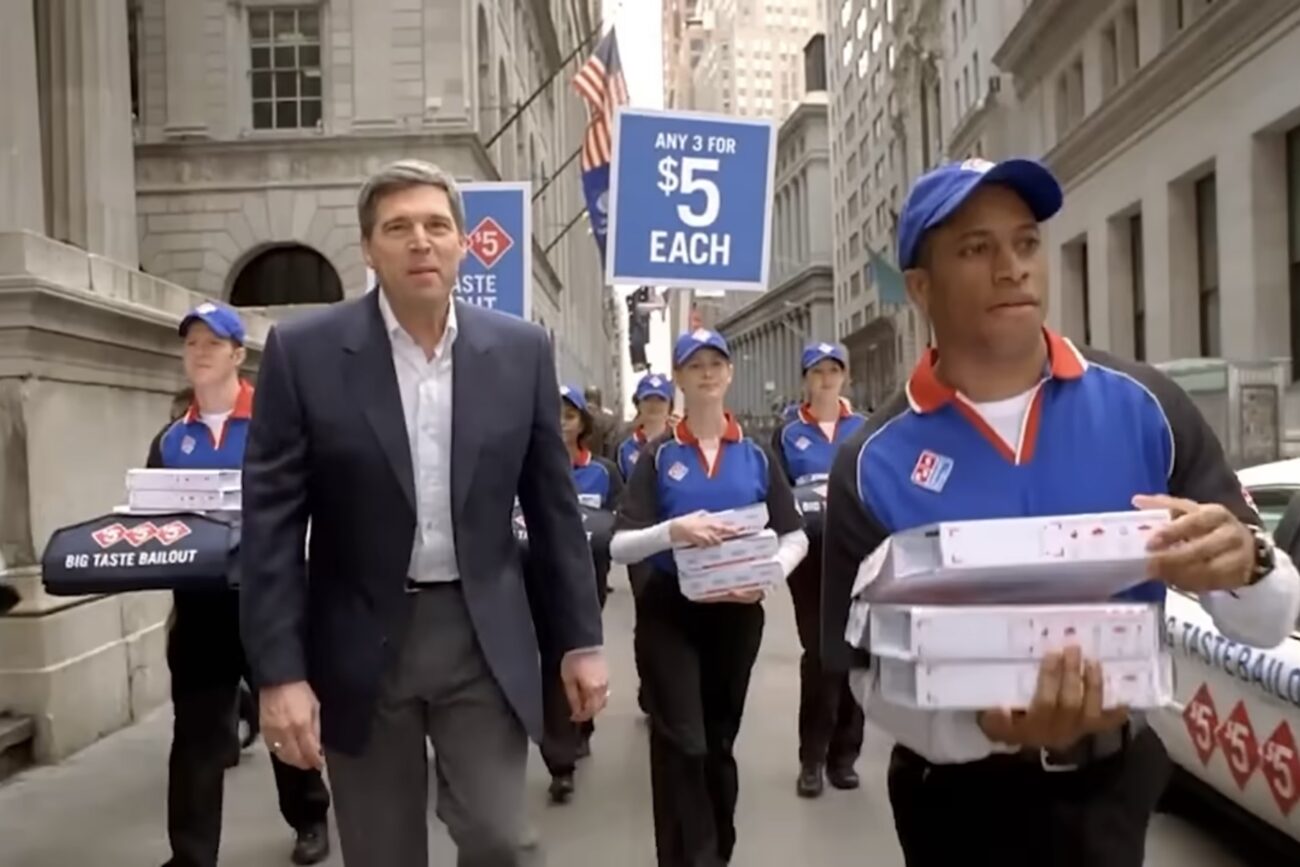
Look at the image below. A suited executive strides down a city street flanked by Domino’s delivery staff, pizza boxes stacked high, signs reading “Any 3 for $5 Each” bobbing behind them. It’s 2009. Wall Street has just been bailed out. Banks are being rescued with public money. And Domino’s, with a straight face and a sharp instinct, has decided to bail out the American public — from bad pizza.

The “Big Taste Bailout” campaign was clever. It was culturally wired in, riding the biggest news story of the year. It got attention. It made people smile. And it changed absolutely nothing.

Because the pizza still tasted like cardboard.

This is the part of the Domino’s story that rarely gets told: before the famous turnaround, there was a brand that already knew how to be witty. It understood timing. It had cultural instincts. What it didn’t have yet was the courage to stop being clever and start being honest. That shift — from smart to real — is what turned a struggling pizza chain into one of the great brand comeback stories of the century.

The Brand That Hit Rock Bottom

By 2008, Domino’s Pizza was in serious trouble. The company that had built its empire on the promise of delivery speed — famously “30 minutes or less” — had sacrificed everything else on the altar of logistics. The pizza was an afterthought. The brand had become a punchline.[1]

Competitors like Papa John’s were hammering them with “better ingredients, better pizza” messaging. Independent pizzerias were winning on authenticity and local pride. Domino’s stock had collapsed to $2.61 per share. Their core promise — fast, not good — had stopped being enough.[2]

Inside the company, they already knew the truth. Focus groups were brutal. Qualitative research confirmed what the internet was saying loudly: the product had a real problem, and the brand had an even bigger one. The Big Taste Bailout had bought them a moment of goodwill. It hadn’t bought them a future. The question was what to do next.

The Brief That Changed Everything

Rather than paper over the cracks, Domino’s — working with agency Crispin Porter + Bogusky — made a decision that bordered on reckless. They would tell the truth. Not spin it, not soften it. Tell it.[3]

“In today’s world of deceit and mistrust, Domino’s will connect with customers by being unexpectedly real and transparent — by actually listening and telling the truth.”

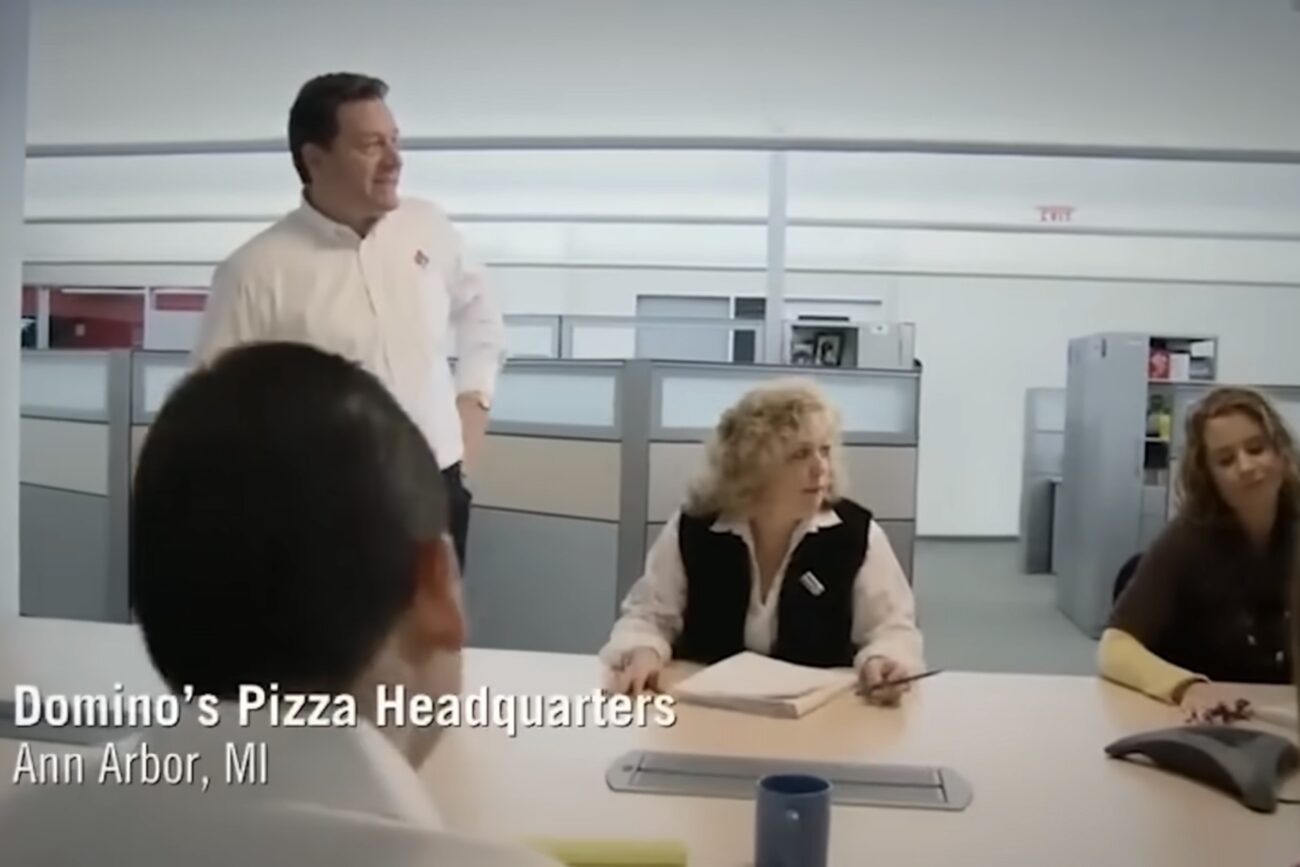
That was the entire creative brief. One line. What followed was the “Pizza Turnaround” campaign, launched in December 2009 and January 2010: a documentary-style video showing Domino’s executives sitting in a conference room, reading real customer complaints aloud, on camera, to the audience.

No crisis management spin. No selective statistics. No brand-speak. The CEO, Patrick Doyle, appeared in a polo shirt — looking, as one writer later observed, like the person in the office cubicle next to you, not a Master of the Universe — and simply said: “There comes a time when you’ve got to make a change.”

Then Domino’s showed the actual process of rebuilding their recipe from scratch: new sauce, new cheese blend, new crust. They created a dedicated website, pizzaturnaround.com. They ran TV spots featuring the most damning customer quotes. They tracked down their harshest online critics — real people, by name — and showed up at their doors with the new pizza.[4]

It was, by any conventional PR logic, an enormous risk.
What Happened Next

The campaign achieved the highest Millward Brown ad-testing score ever recorded at the time it ran. Same-store sales jumped by 14.3% in the first quarter after launch — an industry record. Sales rebounded by 16.5% almost immediately.[5]

The stock price, which had been languishing under $3, began a climb that became one of the great business stories of the decade. Domino’s stock gained more than 2,000% between 2010 and 2017, outperforming Amazon, Apple, Netflix and Google over the same period.[6] The brand that had been a joke became the number one pizza chain in the US, overtaking Pizza Hut in 2017.[7]

None of that came from clever messaging. It came from truth. And from the courage to treat customers like adults.

The Strategic Lesson: Authenticity Is Infrastructure

This is where I want to dwell, because there is a version of this story that turns it into a simple “be honest” fable, and that misses the real lesson.

What Domino’s understood — and what most brands still get wrong — is that authenticity is not a tone of voice. It is not a stylistic choice, something you dial up for your Instagram captions and dial down for your earnings call. Authenticity, in the strategic sense, is the alignment between what you say and what you actually do.

They didn’t just say the pizza was changing. They changed it. They didn’t just promise transparency. They filmed the process. They didn’t just claim to listen. They showed up at the homes of critics with the proof.[8]

The campaign worked because the substance preceded the communication. There was no PR strategy sophisticated enough to rescue a bad product. But a good product, communicated with radical honesty, became something else entirely: a story customers wanted to be part of.

That is the pivot most brands are afraid to make. Admission feels like weakness. Vulnerability feels like exposure. The instinct, almost always, is to protect the narrative — to manage perception before dealing with reality.

Domino’s inverted that logic. And the market rewarded them for it, handsomely, for over a decade.

What This Means in 2026

If anything, the conditions that made Domino’s turnaround possible have intensified. Consumers today are more skeptical of corporate messaging than at any point in modern history. The gap between what brands say and what they do has never been more visible, more scrutinised, or more consequential.

Every brand operates in a permanent focus group now. Social media means that the conversation your customers are having about you — the unfiltered, unsponsored one — is always running, always public, always searchable. The question is no longer whether people are saying it. It is whether you are brave enough to let it inform your strategy.

There is also a cautionary note here, and it matters. Authenticity cannot be manufactured. A brand that decides to “do a Domino’s” without actually fixing anything — that adopts the aesthetic of transparency as a campaign mechanic — will get found out faster than ever. The form only works because the substance was real. The confession only landed because the pizza actually got better.

Strategy is not messaging. Messaging is the last step.

A Final Thought

The Domino’s turnaround has been studied extensively, cited endlessly, and praised from every angle. But the detail that stays with me is this: Patrick Doyle wore a polo shirt.

No stage-managed keynote. No brand anthem. No glossy production values designed to make you feel something carefully calibrated. Just a man in a plain shirt, telling the truth, in a room that looked like every other corporate room.

That image — low on production value, high on credibility — is the whole case study in a single frame. The most persuasive thing a brand can do is stop performing and start being real.

The best campaigns are not built in agencies. They are built on decisions made in boardrooms — on the willingness to face uncomfortable data, to fix what is broken, and to trust that your audience can handle the truth.

Domino’s trusted theirs. That is why, fifteen years later, we are still talking about a pizza company.


References

[1] Business Age. “Worst pizza ever: Domino’s miracle turnaround.” Business Age. businessage.com

[2] UCLA Economics. “Domino’s: The Turnaround.” UCLA, 2012. econ.ucla.edu

[3] Cornell University / Cornellians. “Marketing Wisdom, From the Alum Who Helped Turn Domino’s Around.” Cornell, December 2024. alumni.cornell.edu

[4] Campaign Live. “Case study: How Domino’s and Crispin Porter & Bogusky transformed the pizza chain.” Campaign Live, December 2017. campaignlive.co.uk

[5] Aaron Allen & Associates. “How Domino’s Turnaround Gained Nearly $12b in Enterprise Value.” Aaron Allen. aaronallen.com

[6] CNBC. “Domino’s stock yields higher returns than Google since IPOs.” CNBC, February 2020. cnbc.com

[7] Domino’s Pizza Inc. “2010 Financial Results.” Domino’s Investor Relations. ir.dominos.com

[8] PR News. “How Domino’s ‘Pizza Turnaround’ Became a Masterclass in Food PR.” PR News, September 2025. everything-pr.com

I am an Athens-based visionary marketer and communication specialist, driven by a passion for crafting captivating content that breaks through the noise. My diverse background spanning linguistic and philosophical studies to creative marketing and strategic thinking fuels my creative fire.

The Confession That Saved a Brand: The Domino’s Story

Look at the image below. A suited executive strides down a city street flanked by Domino’s delivery staff, pizza boxes stacked high, signs reading “Any 3 for $5 Each” bobbing behind them. It’s 2009. Wall Street has just been bailed out. Banks are being rescued with public money. And Domino’s, with a straight face and a sharp instinct, has decided to bail out the American public — from bad pizza.

The “Big Taste Bailout” campaign was clever. It was culturally wired in, riding the biggest news story of the year. It got attention. It made people smile. And it changed absolutely nothing.

Because the pizza still tasted like cardboard.

This is the part of the Domino’s story that rarely gets told: before the famous turnaround, there was a brand that already knew how to be witty. It understood timing. It had cultural instincts. What it didn’t have yet was the courage to stop being clever and start being honest. That shift — from smart to real — is what turned a struggling pizza chain into one of the great brand comeback stories of the century.

The Brand That Hit Rock Bottom

By 2008, Domino’s Pizza was in serious trouble. The company that had built its empire on the promise of delivery speed — famously “30 minutes or less” — had sacrificed everything else on the altar of logistics. The pizza was an afterthought. The brand had become a punchline.[1]

Competitors like Papa John’s were hammering them with “better ingredients, better pizza” messaging. Independent pizzerias were winning on authenticity and local pride. Domino’s stock had collapsed to $2.61 per share. Their core promise — fast, not good — had stopped being enough.[2]

Inside the company, they already knew the truth. Focus groups were brutal. Qualitative research confirmed what the internet was saying loudly: the product had a real problem, and the brand had an even bigger one. The Big Taste Bailout had bought them a moment of goodwill. It hadn’t bought them a future. The question was what to do next.

The Brief That Changed Everything

Rather than paper over the cracks, Domino’s — working with agency Crispin Porter + Bogusky — made a decision that bordered on reckless. They would tell the truth. Not spin it, not soften it. Tell it.[3]

“In today’s world of deceit and mistrust, Domino’s will connect with customers by being unexpectedly real and transparent — by actually listening and telling the truth.”

That was the entire creative brief. One line. What followed was the “Pizza Turnaround” campaign, launched in December 2009 and January 2010: a documentary-style video showing Domino’s executives sitting in a conference room, reading real customer complaints aloud, on camera, to the audience.

No crisis management spin. No selective statistics. No brand-speak. The CEO, Patrick Doyle, appeared in a polo shirt — looking, as one writer later observed, like the person in the office cubicle next to you, not a Master of the Universe — and simply said: “There comes a time when you’ve got to make a change.”

Then Domino’s showed the actual process of rebuilding their recipe from scratch: new sauce, new cheese blend, new crust. They created a dedicated website, pizzaturnaround.com. They ran TV spots featuring the most damning customer quotes. They tracked down their harshest online critics — real people, by name — and showed up at their doors with the new pizza.[4]

It was, by any conventional PR logic, an enormous risk.

What Happened Next

The campaign achieved the highest Millward Brown ad-testing score ever recorded at the time it ran. Same-store sales jumped by 14.3% in the first quarter after launch — an industry record. Sales rebounded by 16.5% almost immediately.[5]

The stock price, which had been languishing under $3, began a climb that became one of the great business stories of the decade. Domino’s stock gained more than 2,000% between 2010 and 2017, outperforming Amazon, Apple, Netflix and Google over the same period.[6] The brand that had been a joke became the number one pizza chain in the US, overtaking Pizza Hut in 2017.[7]

None of that came from clever messaging. It came from truth. And from the courage to treat customers like adults.

The Strategic Lesson: Authenticity Is Infrastructure

This is where I want to dwell, because there is a version of this story that turns it into a simple “be honest” fable, and that misses the real lesson.

What Domino’s understood — and what most brands still get wrong — is that authenticity is not a tone of voice. It is not a stylistic choice, something you dial up for your Instagram captions and dial down for your earnings call. Authenticity, in the strategic sense, is the alignment between what you say and what you actually do.

They didn’t just say the pizza was changing. They changed it. They didn’t just promise transparency. They filmed the process. They didn’t just claim to listen. They showed up at the homes of critics with the proof.[8]

The campaign worked because the substance preceded the communication. There was no PR strategy sophisticated enough to rescue a bad product. But a good product, communicated with radical honesty, became something else entirely: a story customers wanted to be part of.

That is the pivot most brands are afraid to make. Admission feels like weakness. Vulnerability feels like exposure. The instinct, almost always, is to protect the narrative — to manage perception before dealing with reality.

Domino’s inverted that logic. And the market rewarded them for it, handsomely, for over a decade.

What This Means in 2026

If anything, the conditions that made Domino’s turnaround possible have intensified. Consumers today are more skeptical of corporate messaging than at any point in modern history. The gap between what brands say and what they do has never been more visible, more scrutinised, or more consequential.

Every brand operates in a permanent focus group now. Social media means that the conversation your customers are having about you — the unfiltered, unsponsored one — is always running, always public, always searchable. The question is no longer whether people are saying it. It is whether you are brave enough to let it inform your strategy.

There is also a cautionary note here, and it matters. Authenticity cannot be manufactured. A brand that decides to “do a Domino’s” without actually fixing anything — that adopts the aesthetic of transparency as a campaign mechanic — will get found out faster than ever. The form only works because the substance was real. The confession only landed because the pizza actually got better.

Strategy is not messaging. Messaging is the last step.

A Final Thought

The Domino’s turnaround has been studied extensively, cited endlessly, and praised from every angle. But the detail that stays with me is this: Patrick Doyle wore a polo shirt.

No stage-managed keynote. No brand anthem. No glossy production values designed to make you feel something carefully calibrated. Just a man in a plain shirt, telling the truth, in a room that looked like every other corporate room.

That image — low on production value, high on credibility — is the whole case study in a single frame. The most persuasive thing a brand can do is stop performing and start being real.

The best campaigns are not built in agencies. They are built on decisions made in boardrooms — on the willingness to face uncomfortable data, to fix what is broken, and to trust that your audience can handle the truth.

Domino’s trusted theirs. That is why, fifteen years later, we are still talking about a pizza company.


References

[1] Business Age. “Worst pizza ever: Domino’s miracle turnaround.” Business Age. businessage.com

[2] UCLA Economics. “Domino’s: The Turnaround.” UCLA, 2012. econ.ucla.edu

[3] Cornell University / Cornellians. “Marketing Wisdom, From the Alum Who Helped Turn Domino’s Around.” Cornell, December 2024. alumni.cornell.edu

[4] Campaign Live. “Case study: How Domino’s and Crispin Porter & Bogusky transformed the pizza chain.” Campaign Live, December 2017. campaignlive.co.uk

[5] Aaron Allen & Associates. “How Domino’s Turnaround Gained Nearly $12b in Enterprise Value.” Aaron Allen. aaronallen.com

[6] CNBC. “Domino’s stock yields higher returns than Google since IPOs.” CNBC, February 2020. cnbc.com

[7] Domino’s Pizza Inc. “2010 Financial Results.” Domino’s Investor Relations. ir.dominos.com

[8] PR News. “How Domino’s ‘Pizza Turnaround’ Became a Masterclass in Food PR.” PR News, September 2025. everything-pr.com

I am an Athens-based visionary marketer and communication specialist, driven by a passion for crafting captivating content that breaks through the noise. My diverse background spanning linguistic and philosophical studies to creative marketing and strategic thinking fuels my creative fire.

Contact Us For A Free Consultation

Back To Top
Essential SSL